By Hon. David Nwaenyi, Ph.D.
In every functional democracy, the legislature serves not only as a lawmaking body but also as the guardian of public resources through its critical oversight function. Oversight ensures that government policies are implemented as approved, funds are properly utilized, and public institutions remain accountable to the people. However, in many emerging democracies, including Nigeria, the effectiveness of legislative oversight remains a subject of growing concern.
In my Local government area (Ideato North), and across other parts of the country, citizens are confronted daily with the visible consequences of weak oversight: abandoned government projects, inflated contracts, poor execution of public works, and the alarming diversion of public funds without timely detection or consequences. Roads and water boreholes are awarded but never completed. Schools are budgeted for but remain on paper. Healthcare facilities receive allocations yet lack basic infrastructure. These failures are not merely administrative lapses; they are symptoms of a deeper institutional weakness in oversight.
As famously observed by political philosopher John Stuart Mill,
“Bad men need nothing more to compass their ends, than that good men should look on and do nothing.”
When oversight is left solely in the hands of a limited number of actors, without active citizen engagement, accountability gaps widen, and public trust erodes.
The Oversight Deficit and Its Consequences in Contemporary Nigeria 🇳🇬
Legislative committees are constitutionally empowered to monitor ministries, departments, and agencies (MDAs), ensuring compliance with appropriation laws and policy directives. Yet, the sheer scale of governance, coupled with limited institutional capacity, makes it practically impossible for legislators alone to effectively supervise every project across the federation.
This gap has enabled:
- The proliferation of abandoned and uncompleted government projects
- Diversion and mismanagement of public funds without timely alarms
- Weak monitoring and evaluation mechanisms
- Delayed or non-existent prosecution of infractions
The result is a vicious cycle where public resources are wasted, development is stalled, and citizens lose confidence in democratic institutions.
Why Public Involvement in Oversight is Imperative
Democracy, by its very nature, is participatory. The people are not merely voters; they are stakeholders in governance. The people are the principals and the elected members of the legislature are their agents. The inclusion of citizens in oversight processes is not only desirable, it is essential.
As Abraham Lincoln famously defined democracy as “government of the people, by the people, and for the people,” it follows that the people must also play a role in ensuring that government works for them.
Public involvement in oversight offers several advantages such as:
- Expanded monitoring capacity across communities
- Real-time reporting of project status and irregularities
- Increased transparency and accountability
- Strengthened public trust in governance
Mechanisms for Citizen Participation in Oversight
To bridge the obvious oversight gap and enhance accountability, the following mechanisms should be institutionalized:
Local Government Area Based Oversight Committees
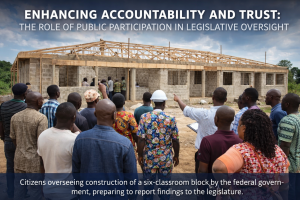
Local government areas should be empowered to form structured oversight groups that monitor government projects within their areas. These groups can provide periodic reports to legislative committees, ensuring grassroots-level accountability.
Digital Reporting Platforms
The creation of accessible digital platforms; mobile applications and web portals; where citizens can upload evidence (photos, videos, reports) of project progress or abandonment will significantly enhance transparency. Such platforms can serve as real-time feedback mechanisms for legislators.
Public Hearings and Open Oversight Sessions
Legislative committees should institutionalize open oversight sessions where citizens, civil society organizations, and the media can participate, present findings, and provide independent assessments of government projects.
Partnership with Civil Society and Professional Bodies
Civil society organizations, engineers, auditors, and policy experts should be formally integrated into oversight processes. Their technical expertise can complement legislative efforts and ensure more rigorous evaluation of projects.
Whistleblower Protection and Incentives
Citizens must feel safe to report wrongdoing. Strengthening whistleblower protection frameworks and offering incentives for credible information will encourage active participation in exposing corruption and mismanagement.
Constituency-Based Oversight Framework
Legislators should establish constituency-level monitoring structures where constituents are directly engaged in tracking projects facilitated through budgetary allocations. This ensures that representation translates into measurable development outcomes.
Building a Culture of Accountability
Effective oversight is not merely about identifying failures; it is about enforcing consequences. Reports generated through both legislative and citizen-led oversight must lead to concrete actions; investigations, sanctions, recoveries, and where necessary, prosecution. Because without consequences, oversight becomes ceremonial.
To this end, I would say that to restore public confidence, there must be a deliberate shift from closed, elite-driven oversight to a more inclusive, participatory, and transparent system. When citizens are actively involved, governance becomes more responsive, and leaders are compelled to act with greater responsibility.
In conclusion, the challenges confronting legislative oversight in Nigeria are significant, but they are not insurmountable. By embracing citizen participation as a core component of oversight, the legislature can significantly enhance its effectiveness and rebuild public trust.
The future of democratic governance depends not only on strong institutions but also on active and engaged citizens. Oversight must no longer be seen as the exclusive preserve of lawmakers; it must become a shared responsibility.
Only then can we move from a system plagued by abandoned projects and mismanaged resources to one defined by accountability, transparency, and tangible development.
Hon. David Nwaenyi, Ph.D.
(Legislative Expert & Public Policy Analyst – with over 10 years of experience in legislative practice)